Thursday, 18 November 2010

Sloping Garden in Gerrards Cross, Bucks - Update 1

Visited site yesterday for the first time since construction started. Although destruction is a more appropriate term for what's going on in the garden at present.


I love this part when the old garden is taken down to reveal the skeleton on which my new design will be built.


This garden has a 3m drop from top to bottom. I'm used to surveying tricky spaces and usually love doing sloping sites. However, this garden was a devil to survey with plants in the way and multiple level changes. The contractors will check my levels carefully before starting construction.


The garden is not huge, so it's very important that all measurements are accurate - even the smallest discrepancy will have an effect on all parts of the plan. The contractors will double check all my measurements before putting in any of the retaining walls.


It's an old property and we're not sure what's under the existing garden, although nothing alarming has shown up so far.

If you'd like help designing your garden please visit my Web site for telephone contact details, or simply email me linsey@linseysgardens.com.

Tuesday, 16 November 2010

Sloping Garden in Gerrards Cross

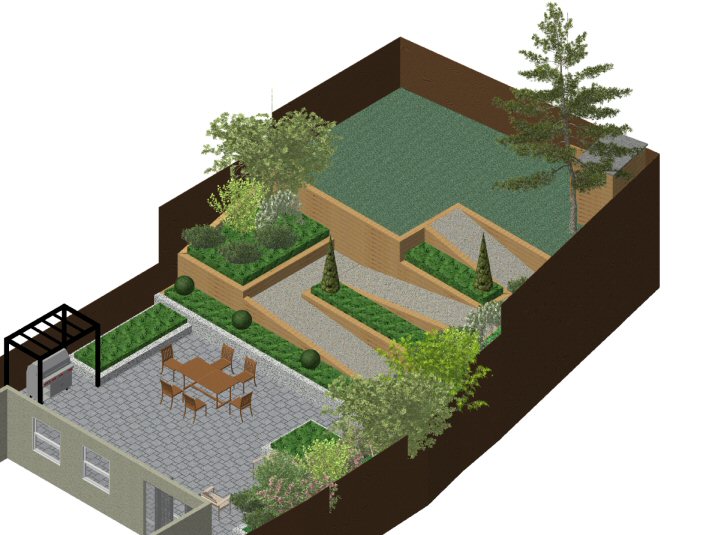
Slopes - I love 'em! This garden in Gerrards Cross is exactly the kind of challenge I like. It is on a steep slope, and the only access is through a church at the rear of the property.

The client has had the interior of this traditional property updated in a more contemporary style and wanted a garden that reflected the inside of the house.


A much larger patio area is required.


The planting has become overgrown and the retaining walls need replacing.


The clients love gardening, but wanted the garden to have more structure and for the planting to be more manageable.


The top of the garden catches the last of the day's sun and the clients requested a large lawn area where they could sit in the evening.


A more gentle route up the garden is required.


Here's the garden is designed for them.


There will be planting and a pergola on the upper lawn terrace although this is not shown on the plan. The green, pointy cones in the ends of the horizontal borders will be Cupressus sempervirens (Italian Cypress) which were requested by the client.


The build started this week and I can't wait to see the garden take shape.

If you'd like help designing your garden please visit my Web site for telephone contact details, or simply email me linsey@linseysgardens.com.

Saturday, 23 October 2010

Fragrant Shrubs for your Winter Garden

Winter can often be overlooked when planning a planting scheme. My clients always ask for year-round interest in their planting schemes, so I have some recommendations for plants that really come into their own in the Winter months.

Some of the most fragrant plants are those which flower in winter. The reason for this is they are trying extra hard to attract the very few insects around at this time of year. Here are some of my favourite winter flowering shrubs:-

1. Daphne odora aureomarginata: this is one of my favourite shrubs. It’s evergreen with a variegated leaf and small pink highly fragrant flowers. It holds a nice tight shape and can be pruned if it gets too big for its allotted space. It will also tolerate shade, and prefers a well-drained alkaline soil.

2. Viburnum bodnantense ‘Charles Lamont’: another great plant that will grow in sun or shade. Give it some space as it can get quite large, although you can keep it pruned. It is deciduous, with clusters of pale pink fragrant flowers on bare branches throughout the winter. It will grow virtually anywhere in any kind of soil.

3. Sarcococca confusa: an evergreen shrub with gorgeous scented white flowers, and an interesting arching habit. You will be able to smell the scent of its rather insignificant flowers all over the garden. It is highly shade tolerant and can be planted under trees. It is not fussy about soil type.

4. Lonicera frangrantissima: a shrubby deciduous honeysuckle with cream flowers with a gorgeous sweet scent. It will tolerate some shade, but does better in full sun. Give it some space as it can get quite large and looks better with just a little light pruning. It will grow in any kind of soil.

5. Osmanthus burkwoodii: this is a fantastic evergreen shrub which makes an excellent hedge. It has white flowers that appear in late winter and are very fragrant. It will grow in sun or shade and any type of soil. It performs best when kept well pruned.

6. Chimonanthus praecox: best grown against a warm, sunny wall. This shrub has pretty yellow, fragrant flowers with brownish purple centres on bare stems throughout the winter. In summer it has attractive glossy, lance-shaped leaves. A lovely fragrant shrub, its stems are often cut and used in flower arranging. It will grow in all soil types.

7. Mahonia x media ‘Charity’: one of my least favourite plants due to its overuse in municipal planting schemes. Mahonia can be used to good effect at the back of a border where its architectural foliage and plumes of yellow fragrant flowers do light up a dull winter day. But do keep it pruned or it will get huge, woody and hideous. It will tolerate shade and any soil type.

8. Hammamelis: commonly known as Witchhazel, this lovely shrub is a must for the winter garden. Delicate, spidery flowers which can be either yellow red or orange appear in late winter on bare branches. The subtle, unusual scent from the flowers is a real treat in the midst of winter. It prefers an acid to neutral soil and will grow in shade. Although it’s deciduous the leaves also provide lovely autumn colour.

If you’d like help with your garden please get in touch. Please visit my Web site and have a look at some of my work.

Wednesday, 13 October 2010

New work from artist Nate Frizzell

Some more amazing art by Nate Frizzell. I had to look twice as I thought it was a photograph. He's so talented.

Saturday, 2 October 2010

Dwarf Japanese Anemones

Anyone who's ever worked with me knows I love Japanese Anemones (particularly Queen Charlotte) and whenever I plant a garden I try to fit some in. The problem with them is they are tall and can get bashed down by the autumn rains. Here's a link to Graham Rice's new plants blog introducing four new dwarf varieties of Japanese Anemone - I'll certainly be using them.

Friday, 1 October 2010

Planning Issues - Landscape Schemes for New Developments

This article in Horticulture Week is yet more proof that landscape schemes around new developments are not being enforced.

It's all very well for people to pay lip service to wanting to improve the landscape around new developments, it's a very popular stance. Introducing legislation to encourage more green space and additional planting is also excellent. However, if the legislation is not enforced and developers know they will get away with not complying they simply will not. How depressing.

Wednesday, 8 September 2010

Creating Walls using Rammed Earth

A very big thank you to my guest blogger Michael Thompson from Rammed-Earth.Org. Michael is an expert on creating beautiful and environmentally friendly rammed earth walls.

An introduction to Rammed Earth by Michael Thompson Rammed-Earth.Org

When I first stumbled upon rammed earth, I was no eco warrior. The most I ever did to save the planet was recycle my empty beer cans. But building with earth turns out to be a very sustainable thing to do...

The rammed earth building method is a very clean process that produces a smooth finish and avoids the heavy cost to the environment of building with bricks and blocks; but best of all, It's dirt cheap!

Using rammed earth involves a process of compressing a mixture of damp earth that has suitable proportions of sand, gravel and clay into an externally supported former that moulds the shape of a wall section creating a solid block of earth. Traditional stabilisers such as lime or even animal blood can be used to stabilise the material, but cement has been the stabiliser of choice for modern times.


The use of cement is contentious as its manufacture creates ten percent of manmade carbon emissions. However, this may be substantially offset by the partial substitution of cement with alternatives such as ground granulated blast furnace slag or by using hydrated lime.

Formwork is set up to create the desired shape of the section of wall and damp subsoil is placed inside the former to a depth of around 100 to 150mm. A pneumatically powered backfill tamper - something like a hand-held pogo stick with a flat plate on the bottom (or alternatively a manual tamper) is then used to compact the material to around fifty percent of its original volume. Further layers of material are added and the process is repeated until the wall has reached the required height.

A rammed earth wall is so solid that the former can be removed immediately. However it will require a number of warm dry days after construction to dry and harden. The structure can take up to two years to cure completely and the more it cures the stronger the structure becomes. When the process is complete, it is much like constructing a handmade wall of solid rock.
In modern variations of the method, rammed earth walls are constructed on top of conventional footings or a reinforced concrete base. To add interest to the structure, some builders add coloured oxides or items such as bottles or pieces of timber.


Because rammed earth structures utilise locally available materials, they typically have a low embodied energy rating and generate very little waste. Earth used for building is a widely available resource and harvesting it for use in construction has minimal environmental impact.
Insects won't infest rammed earth and if unstabilised the material is reusable and biodegradable.

Rammed earth is not only an economically viable construction technique; it also results in a visually pleasing end product.

To find out more please visit my Web site and browse through all the photos and videos or even buy my recently published DIY Rammed Earth Manual.

Maybe i'll meet you on one of my rammed earth courses one day...

Michael RammedEarthOrg
Oh, and one more thing,
Reduce - Re-use - Recycle, One Planet... TO THE MAX!