Friday, 20 January 2012

Garden Design Tips 3 - Triangulation

Before you can start designing a garden you’ll need to know its exact size and shape. You cannot create a plan of the new garden until you have an accurate plan of the existing garden. If you have a small garden to design it is especially important that your measurements are extremely accurate.

One of the problems you’ll find when measuring your garden is it almost certainly not a perfect square or rectangle. One of the simplest techniques for measuring a plot that is full of odd shapes and angles is triangulation. Here’s how to do it.

Use the house as a fixed point from which to take measurements. Choose two points that are not too close together, for example, the two end corners. Take a measurement from each of the two fixed points to the point you are trying to plot.

In order to plot the measurements onto paper you’ll need a pair of compasses. On a scale ruler select the the same one as you used to draw in the house and open the compasses to the length of the distance from the first point. Put the point of the pair of compasses on the first point of the house and draw an arc. Repeat the previous step for the distance from the second point. Where the two arcs cross is the position of whatever you are trying to measure, in the case of the example below it is the position of the two corners of the rear garden.


You can use this technique to find the position of anything in the garden. In order to measure accurately use the same two fixed points for each measurement.


If you need help designing your garden please feel free to email me linsey@linseysgardens.com. You can visit my Web site and see some of my completed projects and get a bit more information.

Friday, 13 January 2012

BBC Radio Berkshire Interview

Anyone who's interested in hearing what I sound like can tune into BBC Radio Berkshire (95.4 FM) next Tuesday 17th January 2012. I'm being interviewed live between 3pm and 4pm.

Thursday, 12 January 2012

Garden Design Tips 2 - Paint it Black

Anyone who has read my blog before will almost certainly be aware of my fondness for painting wooden structures in the garden black. Clients get a bit nervous when I tell them I want to paint fences black. They are afraid a black boundary will make the garden seem smaller in the same way that painting internal walls a dark colour makes a room feel boxy. It doesn’t work the same way outside.

Black is a wonderful colour for garden structures. It is the colour of shadow and diminishes the impact of potentially unattractive structures such as fences and sheds. Once the planting has started growing in around them black-painted structures simply blend into the background. Black also makes a fantastic backdrop for plants. The gold leaves of Choisya ternata 'Sundance', the bright red new foliage of Photinia ‘Red Robin’, a swathe of burnt orange Hemerocallis, drifts of pale pink Phlox are all more dramatic set against a black fence. A coat of black paint on a tired fence or an old shed can really transform a garden with very little outlay.


A black summer house blends into
the shadows of the trees and hedge.


I’ve heard the argument that green is the best colour for painting garden structures because it is a natural colour. Firstly, there is nothing remotely natural about the horrid green dyes that manufacturers use to colour wood preservatives. Secondly, why would you want to place plants against a flat, green canvas? It just looks bland as the outline forms of the plants are lost. Don’t even get me started on that rancid bright orange colour that is so widely used for fences. Just one word – why?!!


This black fence in a small garden
helps the boundary to disappear
making the garden seem larger and
displaying the standard Photinia
'Red Robin' to great effect.


Cuprinol Timbercare comes in black, but you’ll need to go to a Dulux Centre or buy it on-line as I’ve never found black in any of the DIY stores near me. However, I’d recommend the more expensive Cuprinol Garden Shades which gives a slightly glossy finish and lasts years. Look on-line for bargains, eBay is always a good start.


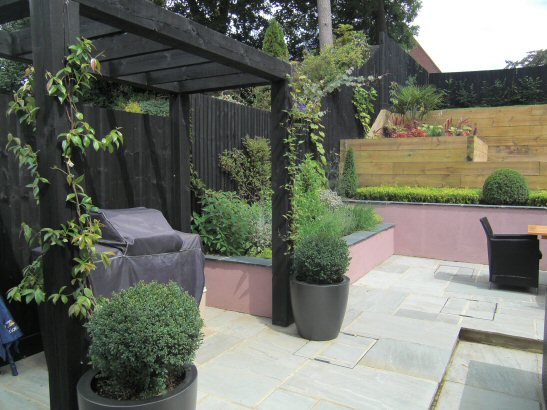
Black fences and a black pergola in
this contemporary garden scheme
give a crisp finish and blend the
garden into the wider landscape.


If you need help designing your garden please feel free to email me linsey@linseysgardens.com. You can visit my Web site and see some of my completed projects and get a bit more information.

Thursday, 5 January 2012

Garden design tip - Use Bold Structures in Small Garden Design

When designing a small garden it’s tempting to scale down the garden features so as not to clutter the space. The result can often be a muddle of insignificant elements that do the exact opposite. A good tip when designing a small garden is to keep things simple. Use clean lines and geometric shapes. Don’t overcomplicate the design and use a single, bold structure to hold focus inside the garden.

A chunky pergola or a rendered blockwork wall around a seating area will create a sense of enclosure, introduce a touch of drama and ensure that your eye stays inside the garden rather than straying to an unattractive view outside the garden.

A pergola for screening the terrace in a small, sloping, Gerrards Cross garden

For a substantial, impactful pergola use 150mm square timbers. Your local timber yard will cut the timber to the exact length needed and can often be persuaded to cut out notches in the posts for easier assembly. You may need to get some muscle to lift the timber and will definitely need the help of a carpenter.


A pergola over a dining area in a small garden in Berkshire.

For a dramatic screening wall use concrete blocks up to a height of 1.8m which is the maximum allowable in a garden without planning permission. Render the wall and paint it a cheerful, bright colour to add an instant contemporary feel to the garden.

A blockwork wall enclosing a dining area in a Windsor garden.

If you need help designing your garden please feel free to email me linsey@linseysgardens.com. You can visit my Web site and see some of my other completed projects and get a bit more information.

Monday, 12 September 2011

Windsor Garden Design with a Mediterranean courtyard

This small, shallow Windsor garden needed a complete re-design. The garden is overlooked on both sides, but not from the back. The brief was to create a contemporary garden with a Mediterranean flavour that would be easy to look after. The client requested a large terrace by the house for sunbathing and eating, and a second more intimate seating area separated from the rest of the garden.


There was an enormous Leyland Cypress hedge, plus some over grown Laurels and other evergreen shrubs that combined to give a thick screen along the back boundary. The client liked the feeling of privacy and safety these gave.


Initially, it was intended to keep the Cupressus hedge, but it soon became apparent that if we removed the shrubs the hedging would then have ugly dead patches. In the end it was the client’s decision to remove all existing trees and shrubs and start again. I was relieved as not only do I think the old trees and shrubs were past their best, it’s always nice to be given a blank canvas.


Here’s the scheme I designed:-


Week one – clearing. The saying goes ‘you need to break a few eggs to make an omlette’ and this was Greg Tranckle Landscapes version of egg breaking! Everything was removed from the garden.


Week two and the the old garden is gone, a new fence is installed and the excavations start for the new garden. A footpath runs along the back of the property and the client wanted the fence to be the maximum height to discourage casual intruders.


Week four and the courtyard is taking shape. The blockwork walls are up to their full height and Greg and the lads have constructed the arched windows that give the courtyard a more Mediterranean feeling.


Week five and the courtyard is really starting to look finished. The circular steps are constructed and the render is on the walls. The water feature blade on the front outside wall of the courtyard is in place and the reservoir is constructed.


I think I’ve lost the battle to paint the courtyard walls pink – the debate about colour is ongoing. I really want the walls to be a strong, statement colour, but the client is understandably nervous.

Keep following – I’ll post more progress shots in a few days.

If you need help designing your garden please feel free to email me linsey@linseysgardens.com. You can visit my Web site and see some of my other completed projects and get a bit more information.

Monday, 18 July 2011

Garden Design Ideas - Small Shallow Garden - Update 5

This small, shallow garden in Warfield (Berkshire) is so nearly finished, just not quite!


Everything is constructed. The walled alcoves have had their Slate cladding applied. The walls have been painted a fetching purple - love it! The fences, trellises and pergola have been painted black. The paving is laid. The lawn is laid.


Now the garden is infested with electricians. Their stuff is everywhere, so I can't get good photos, grrrrrrrr!! Just kidding. The fabulous Dilwyn Jones and his lovely assistant Noel, are doing a sterling job. The decorative and task lighting are being fitted. The water feature will go in and be connected last.


The garden is a positive hive of activity still with Gareth taking care that the paint job looks perfect and Matt still painting trellis (sorry, I know it's a fiddly, boring job).

The barbeque alcove has worked really well and will function as a small outdoor kitchen.


Next comes the planting - watch this space .......

If you need help designing your garden please feel free to email me linsey@linseysgardens.com. You can visit my Web site and see some of my other completed projects and get a bit more information.

Saturday, 16 July 2011

In Which I Enter the Naphill Horticultural Society Summer Show 2011

I was brought up in a village called Naphill in Buckinghamshire. My Mum still lives there and I visit her all the time. I try to arrange my visits so that I’m there when the the local Horticultural Society shows are on. I remember these so well from my childhood. I loved the earthy smell of the flowers and vegetables, the tables packed with home made cakes and jam, the tiny gardens on plates, and the hum of companionable conversation. It was a comforting, sociable experience.

Last year when my Mum and I walked around the show I was saddened by how few entries there were in many of the classes. You would think with all the interest in growing your own food that the number of entries in these shows would be increasing. But I guess busy lives mean people feel they don’t have the time to prepare their entries.

My family always enters something – Mum usually wins with her fabulous Victoria sponge and something hand made, and my aunt Thelma is always victorious in all the floral design classes. So, this year I decided to stop moaning and do something myself.

I went into the whole thing with the sole intention of swelling the numbers, supporting the organizers and spending a day doing something with my Mum that we’d both enjoy. However, I never do anything by halves and put a lot of time and effort into making my entries look as good as I could. I got up 6am on a Saturday for goodness sake, now that’s dedication!

I had a great time and won loads of prizes. It was totally satisfying. I felt I had done my bit to support the Naphill Horiticultural Society and I spent a relaxing afternoon talking to some of my ex-neighbours who I had not spoken to for years. I loved it and can thoroughly recommend it. Here is the photographic evidence of my successes:-

A vase of annuals - First prize


A vase of perennials - First prize


Beetroot - second prize - I'm nurturing some better specimens for the autumn show...


Rhubarb - first prize


Potatoes - a surprising first prize, I almost didn't put them in!


Collection of Herbs - A disappointing third prize - I'll do better next time...


Redcurrants - an annoying nothing as I misread the entry form and put one too few bunches in!


Last, but by no means least, my triumphant cheese and onion tart which at first was deemed by the judge as looking suspiciously perfect (luckily Janet who was walking round with judge assured her it was home made). First prize and best overall entry in the domestic category. Woo Hoo!


I also entered some fruit scones which got a third prize - they tasted great, but had collapsed so I didn't hold out much hope.

So come on people! Please support your local horticultural society, even if you just enter a few annuals or perennials from your garden it helps fill up the classes. You will meet people you never usually socialise with and maybe make a few new friends. It's a pleasant, relaxing way to spend a day and who doesn't occasionally long for simpler times in this age of high speed, high tech, result driven, stress filled days?

If anyone wants a copy of my super, award-winning cheese and onion tart please email me linsey@linseysgardens.com and I'll be delighted to send you a copy.

If you need help with designining your garden please visit my Web site and get in touch.