Showing posts with label Garden Design Ideas. Show all posts

Tuesday, 2 July 2019

Garden Design Buckinghamshire - Gabion Retaining Walls

Gabions are really useful when you can't dig footings but need to retain soil or create raised beds.  They can be built on compacted ground, or a small bed of compacted MOT Type 1 hard core (scalpings).

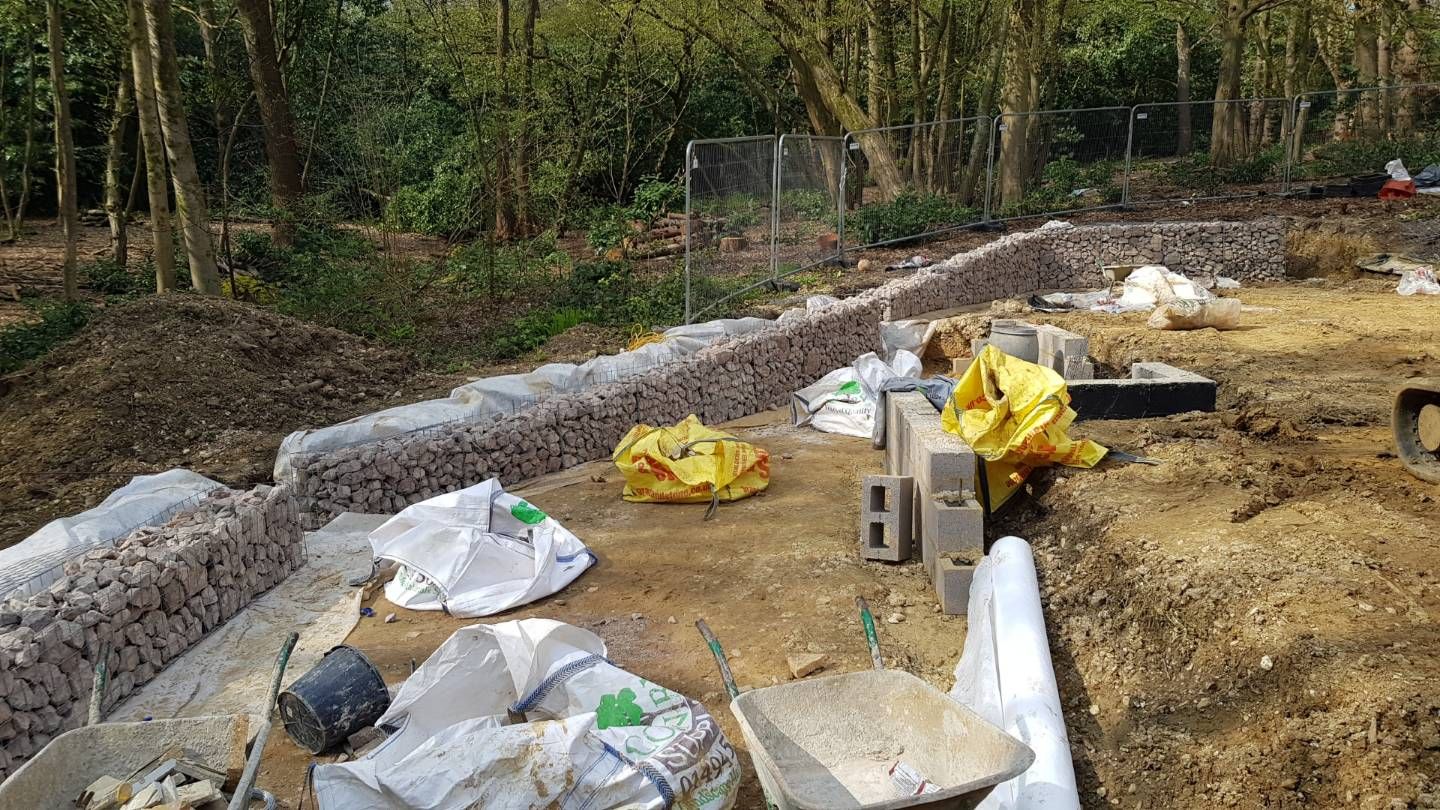
 Garden Design - Denham - Buckinghamshire - under construction 
I have designed gardens around four new houses for a property developer on this sloping site in Denham, Buckinghamshire.  The site is surrounded by woodland and the tree roots cannot be disturbed.


  Garden Design - Denham - Buckinghamshire - under construction

 The boundaries of the gardens have been defined using gabion baskets filled with stone to retain the new terraced levels and create separation from the adjoining woodland.  The gabion retaining walls blend well into their surroundings and do not interfere with the tree roots.  This is an aesthetically pleasing way to deal with a practical problem.

Garden Design - Denham - Buckinghamshire - under construction

Gabions are also quick to build and therefore much cheaper than brick or blockwork.  However, they must be built carefully so that they lean back into the slope they are retaining - this is called a batter.  They also need quite a substantial - usually 1m wide - bottom course.  The front of the gabion basket should also be wired into a supporting post behind the gabion at intervals to stop the baskets bowing outwards when filled.

Garden Design - Denham - Buckinghamshire - under construction

You can keep costs to a minimum by using a gabion stone like this one from Miles Stone which is simply tipped into the gabion baskets.  A more polished look can be achieved, like these curved gabion walls with a stacked stone facing in my St Albans, Hertfordshire garden design.  However, these will take longer to construct, require a larger quantity of more expensive fill material and therefore cost more - sometimes almost as much as a brick or blockwork wall.


Garden Design - St Albans - Hertfordshire

If you'd like me to design your perfect garden please get in touch.  You will find all contact details as well as other examples of my work on my Web site.  You can see more of my work on my Facebook page. 

Thursday, 11 October 2018

Garden Design Tips - 7 Things to do in your garden right now


There are plenty of things to get on with in your garden in the Autumn.  Some people don't like to tidy up too much, preferring to leave piles of leaves and hollow stems on plants for insects to shelter in over winter.

However, there are some things that you can do that won't discourage insects and will give your garden a head start on next year.

1.  Plant new shrubs and hedging – autumn is the best time to put in plants.  They are not quite yet dormant so will start to establish whilst there is a little warmth in the soil.  Then in spring they have a headstart and will grow on more quickly than spring plantings.

 
2.       Plant spring bulbs – late winter and early spring are dull times in the garden.  Plant Snowdrops, Anemone blanda, Crocus, Narcissus, Tulips and Alliums for a show that will start in December and go on into the early summer.


3.       Tidy the lawn – scarify and aerate the lawn. Give it an autumn feed – there are different types of feed for spring and autumn, make sure you choose the right one.  Apply moss killer and lawn weedkiller then fill any resulting bald patches by sprinkling on a bit of topsoil and some new grass seed.


4.       Prune shrubs apart from those that flower on the current year’s growth such as Forsythia. Remove dead branches and any that are crossing.  Reduce the size of the plants to keep them in their allotted position and make sure they don’t encroach on paths or neighbour’s gardens.


5.       Prune Wisteria. Remove all long, whippy shoots as these will weaken the plant.  Prune all side shoots off the main framework of the plant back to about 4 buds.  Remove all dead growth and, if necessary, reduce the overall size of the plant to keep it in its allotted space.  You will get many more flowers if you prune the plant quite hard, but do not remove all the flower buds – the fat growths you can see in the leaf junctions with the stem.


6.       Turn your compost over and add some cardboard.  Too much green waste, especially grass, will make the compost slimy and smelly, adding shredded cardboard will prevent this.  You can also enrich the compost by adding some stable manure from any local yard - the best compost comes from well=rotted stable manure when the horses are bedded on shavings. 


7.       Take some hardwood cuttings.  Especially useful for plants that might not make it through a hard winter.  Cut off a stem at the base of the plant.  Remove the soft growth tip and cut the stem into sections with a diagonal cut just above a bud.  Dig over a strip of garden and insert the diagonal cut ends of each cutting into the trench and firm the soil around each one.  Or, you can put them around the edge of a plastic pot filled with multi-purpose compost. Throw a piece of garden fleece over the cuttings when the temperature drops.


If you'd like me to design your perfect garden please get in touch.  You will find all contact details as well as other examples of my work on my Web site.  You can see more of my work on my Facebook page.

Sunday, 6 August 2017

Contemporary Sloping Garden Design, Crowthorne, Berkshire

This awkward shaped garden in Crowthorne, Berkshire was in great need of a makeover. The plot slopes from back to front as well as across its width and wrapped around the house in an 'L' shape.
The clients wanted a contemporary style, low maintenance garden where they could spend time entertaining friends and family.

The brief was to create more useable space, a large seating and dining terrace by the back of the house, an area of lawn and a place to enjoy the evening sun.  The rear garden needed to be secure and private and a new driveway was required at the front of the house with easy access and parking for two large cars. 


 Front garden Crowthorne, Berkshire - Before


 Front garden Crowthorne, Berkshire - After

The new front driveway was paved with stabilised gravel and has a raised planter as well as planting along the boundary to soften the space.  Two cars can get in and out and park easily on the new driveway which also includes an area for bin storage and a new front step.  The front driveway is secured from the rear garden with a single-rail pergola with baton screens and a lockable gate that matches the baton screens.


  Rear garden Crowthorne, Berkshire - Before


 Rear garden Crowthorne, Berkshire - After - Upper Terrace

The rear garden comprises three outdoor rooms at different levels.  There is a raised terrace immediately accessible from the kitchen with built-in benches, rendered blockwork walls, black Limestone paving and a Bio ethanol fireplace table with a black Limestone top.  The terrace is enclosed by a single rail pergola and baton screens which also help to disguise the old concrete garage. The wood is painted black to give a contrast to the white painted walls and provide a dramatic backdrop to the planting.


Rear garden Crowthorne, Berkshire - Before


  Rear garden Crowthorne, Berkshire - After - Lawn Area


From the terrace there is an archway between baton screens with cut out windows lined with brushed steel frames.  There is a step down through the archway onto a lawned area with herbaceous borders full of pretty summer flowering perennials and grasses.


Rear garden Crowthorne, Berkshire - Before


Rear garden Crowthorne, Berkshire - After - Lower Courtyard Area


From the lawn there is a step down into a small courtyard area with outdoor sofas and raised beds sheltered by a pergola.  This area is perfect for enjoying an evening drink catching the last rays of the sun.  It is a peaceful, intimate space that feels private and relaxing.


Rear garden Crowthorne, Berkshire - Before


Rear garden Crowthorne, Berkshire - After - Lower Courtyard Area

If you'd like me to design something that is perfect for your lifestyle and requirements please get in touch.  You will find all contact details as well as other examples of my work on my Web site.  You can see more of my work on my Facebook page.

Monday, 5 June 2017

Garden Design Ideas - Symmetry in Design

A garden with no underlying structure and design is just a series of random pieces of hard landscaping placed around the available space with no interconnection. It will neither look beautiful or be somewhere you want to spend much time.  A good garden design should make the space feel cohesive and will be somewhere that is pleasant to spend time in as well as looking beautiful.

The garden design process imposes a strong underlying structure using interlocking symmetrical shapes that define and connect the garden areas.  The design holds together, one area flows naturally into the next and there is a sense of movement around the garden that makes maximum use of the available space.  This ensures that all the garden is used because it feels natural and comfortable and navigating between the spaces is safe, interesting and pleasant.

Here’s a very basic example of how symmetrical shapes can be used to create a garden design plan.

Step 1 - choose some geometric shapes and lay them over one another.


Step 2 - add some colour to start defining the pattern. 

 Step 3 - Build on the pattern by adding more shapes.  Here another larger circle has been added under the smaller circle and a large square links the whole design together.


Step 4 - By replacing the colours with textures and patterns that denote stone paving, wood decking, lawn, gravel and planting the pattern is transformed into a plan.

Although no garden would ever this symmetrical, this very simple example illustrates the point that the symmetry of the shapes is key to holding the design together and creating something that looks cohesive.  The design already has recognisable garden elements like lawn, paths, a deck and seating area with some planting, and natural transitions between the areas.

Once the basic layout has been created it can be developed and adjusted to ensure all the areas are the correct sizes for their intended purpose - you may need a larger paved area in order to accommodate a larger table.  You can add a pergola over the path or the deck.  The borders can be raised by adding some retaining walls.

This is one of the techniques that a garden designer uses to ensure a garden scheme works for each different client's requirements and the topography of their plot.

If you'd like me to design something that is perfect for your lifestyle and requirements please get in touch.  You will find all contact details as well as other examples of my work on my Web site.  You can see more of my work on my Facebook page.


Tuesday, 27 September 2016

Planting Design - Spring Bulbs


Autumn is well underway and it’s a great time to start thinking about planting bulbs.  There’s nothing more cheering than a cluster of creamy narcissus on a dull spring morning.
I choose bulbs to create a succession of colour and interest from the first Snowdrops in January right through to the Alliums in June.  Order online through J Parker or GeeTee for great choice and prices.

Galanthus nivalis (Snowdrops) flower in January, plant in large drifts.


Next up are Crocus which will provide much needed colour throughout February and March.  I get a mixture of the large flowered and species and plant where you can see them.  They grow well in pots of naturalised in lawns and boders.  


Anemone blanda will poke up their heads in borders, under trees and in pots from March through ‘til April.  Their delicate nodding heads among fern-like leaves have earned them the common name Windflower.


Plant narcissus and daffodils in pots or naturalise in grass.  I keep mine in pots as I don’t like having the leave the scruffy looking foliage in my borders.  I simply hide the pots when they’ve flowered and bring them out again the next year.

I love this Narcissus Thalia – it’s scented and a lovely cream colour.


 Tulips will flower throughout April and May.  I prefer the pastel colours to the gaudy reds, but it’s a matter of personal preference.  There are so many different varieties to choose from including the blowsy paeony flowered and parrot types.  I usually select a mix of early and late flowering varieties and plant them in pots.  They don’t like to get too wet and do not last very long in the ground, so need to be re-planted every couple of years.


Alliums are perfect for bringing colour to your borders before herbaceous plants start to kick in.  Different varieties will flower from June onwards into July.  I like ‘Purple Sensation’ and ‘Christophii’.


If you would like help designing your garden, please drop me an email, or visit my Web site for telephone contact details.  You can also see examples of my work on my Facebook page and Houzz profile.