Showing posts with label Garden Design Oxfordshire. Show all posts

Tuesday, 2 July 2019

Garden Design Buckinghamshire - Gabion Retaining Walls

Gabions are really useful when you can't dig footings but need to retain soil or create raised beds.  They can be built on compacted ground, or a small bed of compacted MOT Type 1 hard core (scalpings).

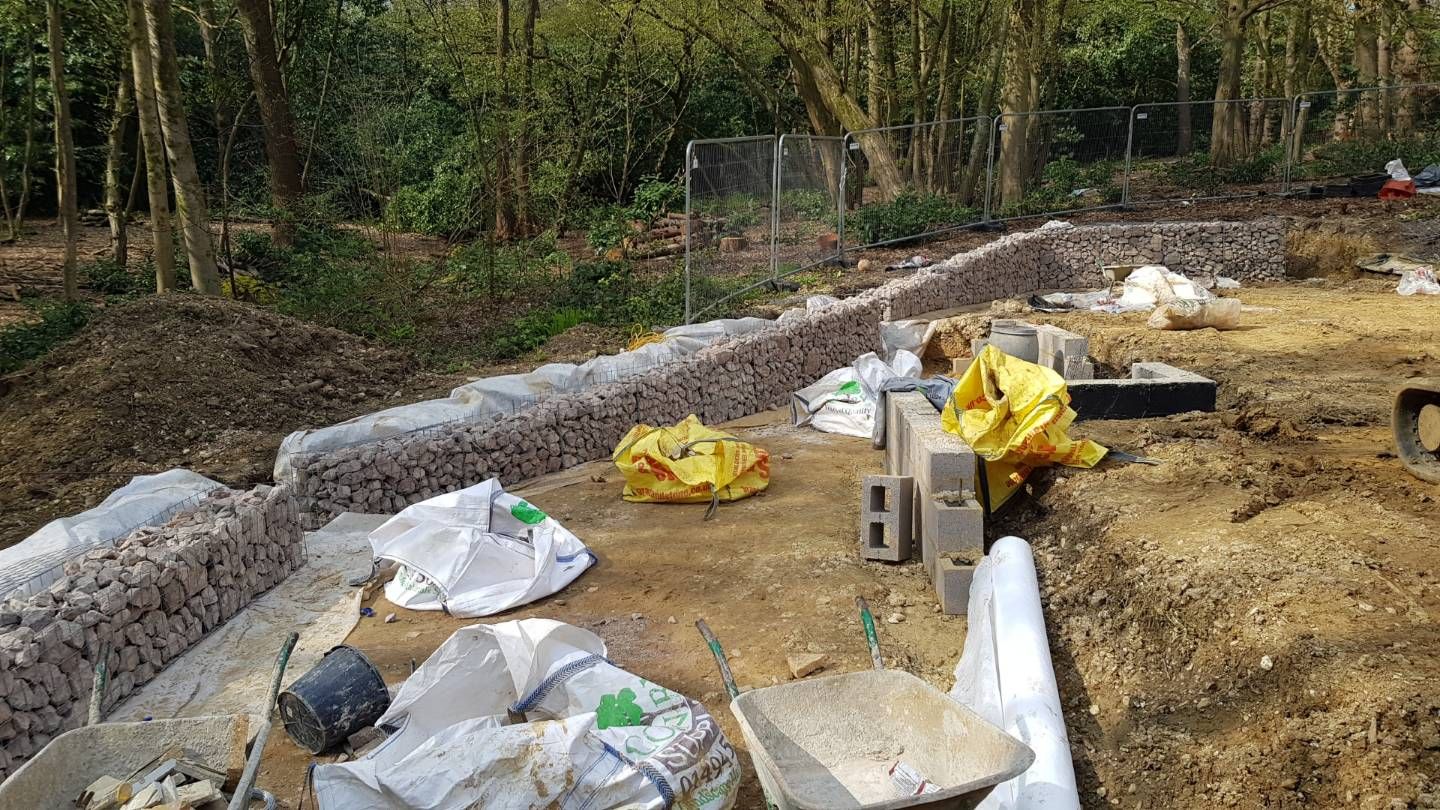
 Garden Design - Denham - Buckinghamshire - under construction 
I have designed gardens around four new houses for a property developer on this sloping site in Denham, Buckinghamshire.  The site is surrounded by woodland and the tree roots cannot be disturbed.


  Garden Design - Denham - Buckinghamshire - under construction

 The boundaries of the gardens have been defined using gabion baskets filled with stone to retain the new terraced levels and create separation from the adjoining woodland.  The gabion retaining walls blend well into their surroundings and do not interfere with the tree roots.  This is an aesthetically pleasing way to deal with a practical problem.

Garden Design - Denham - Buckinghamshire - under construction

Gabions are also quick to build and therefore much cheaper than brick or blockwork.  However, they must be built carefully so that they lean back into the slope they are retaining - this is called a batter.  They also need quite a substantial - usually 1m wide - bottom course.  The front of the gabion basket should also be wired into a supporting post behind the gabion at intervals to stop the baskets bowing outwards when filled.

Garden Design - Denham - Buckinghamshire - under construction

You can keep costs to a minimum by using a gabion stone like this one from Miles Stone which is simply tipped into the gabion baskets.  A more polished look can be achieved, like these curved gabion walls with a stacked stone facing in my St Albans, Hertfordshire garden design.  However, these will take longer to construct, require a larger quantity of more expensive fill material and therefore cost more - sometimes almost as much as a brick or blockwork wall.


Garden Design - St Albans - Hertfordshire

If you'd like me to design your perfect garden please get in touch.  You will find all contact details as well as other examples of my work on my Web site.  You can see more of my work on my Facebook page. 

Thursday, 11 October 2018

Garden Design Tips - 7 Things to do in your garden right now


There are plenty of things to get on with in your garden in the Autumn.  Some people don't like to tidy up too much, preferring to leave piles of leaves and hollow stems on plants for insects to shelter in over winter.

However, there are some things that you can do that won't discourage insects and will give your garden a head start on next year.

1.  Plant new shrubs and hedging – autumn is the best time to put in plants.  They are not quite yet dormant so will start to establish whilst there is a little warmth in the soil.  Then in spring they have a headstart and will grow on more quickly than spring plantings.

 
2.       Plant spring bulbs – late winter and early spring are dull times in the garden.  Plant Snowdrops, Anemone blanda, Crocus, Narcissus, Tulips and Alliums for a show that will start in December and go on into the early summer.


3.       Tidy the lawn – scarify and aerate the lawn. Give it an autumn feed – there are different types of feed for spring and autumn, make sure you choose the right one.  Apply moss killer and lawn weedkiller then fill any resulting bald patches by sprinkling on a bit of topsoil and some new grass seed.


4.       Prune shrubs apart from those that flower on the current year’s growth such as Forsythia. Remove dead branches and any that are crossing.  Reduce the size of the plants to keep them in their allotted position and make sure they don’t encroach on paths or neighbour’s gardens.


5.       Prune Wisteria. Remove all long, whippy shoots as these will weaken the plant.  Prune all side shoots off the main framework of the plant back to about 4 buds.  Remove all dead growth and, if necessary, reduce the overall size of the plant to keep it in its allotted space.  You will get many more flowers if you prune the plant quite hard, but do not remove all the flower buds – the fat growths you can see in the leaf junctions with the stem.


6.       Turn your compost over and add some cardboard.  Too much green waste, especially grass, will make the compost slimy and smelly, adding shredded cardboard will prevent this.  You can also enrich the compost by adding some stable manure from any local yard - the best compost comes from well=rotted stable manure when the horses are bedded on shavings. 


7.       Take some hardwood cuttings.  Especially useful for plants that might not make it through a hard winter.  Cut off a stem at the base of the plant.  Remove the soft growth tip and cut the stem into sections with a diagonal cut just above a bud.  Dig over a strip of garden and insert the diagonal cut ends of each cutting into the trench and firm the soil around each one.  Or, you can put them around the edge of a plastic pot filled with multi-purpose compost. Throw a piece of garden fleece over the cuttings when the temperature drops.


If you'd like me to design your perfect garden please get in touch.  You will find all contact details as well as other examples of my work on my Web site.  You can see more of my work on my Facebook page.

Thursday, 28 June 2018

Garden Design - Caterham, Surrey

I've just finished designing this contemporary family garden in Caterham, Surrey for a young couple with two children.

 Garden Design, Surrey - Before

Although the garden has to be family and dog friendly the brief was to create a contemporary garden to match the recently refurbished house with its modern extension.  The garden is large and rather bland, but the clients love the space, and privacy.  They gave me a brief that included keeping the vegetable garden, sheds, compost area and greenhouse at the rear of the garden, but integrating them into a more interesting garden.

 Garden Design, Surrey - Visual of water feature

 I divided the garden into distinct zones, without cutting off the clients view down the garden.  I created a new focal point in the vegetable garden through the existing arch.  A piece of sculpture will be chosen to create drama and interest and lead the eye down the garden.

Garden Design, Surrey - Visual of garden towards house

The first zone is a large entertaining terrace that gives a seamless transition from the inside to the outside making it an extension of the house and useable for most of the year.  This area has an outdoor kitchen and a water feature with steel grille and inset glass stepping stones with water cascades down the perimeter walls.  There is plenty of space for a large dining table and outdoor sofas.

Garden Design, Surrey - Visual of new terrace

In the centre of the garden there is a sunken seating area with a sculptural water feature and built-in benches.  This area is surrounded by perennial planting and has pathways leading in from the sides of the gardens with metal arches to match the existing arch into the vegetable area.

Garden Design, Surrey - Visual of sunken seating area through arches

Down the side of the garden there are raised planting areas and others in more shade areas that lead into the lawned area of the garden from a shady perimeter walkway that children can run around to access the existing play area at the bottom of the garden.

Garden Design, Surrey - Visual of sunken seating area

An existing, raised area to one side of the garden has been maintained, but tweaked to fit in with the overall symmetry of the new garden scheme.

If you'd like me to design your perfect garden please get in touch.  You will find all contact details as well as other examples of my work on my Web site.  You can see more of my work on my Facebook page.


Tuesday, 26 June 2018

Garden Design - New Projects in Surrey and Berkshire

I'm working hard at the moment and have a number of new projects just coming off my virtual drawing board.  Here is a small sample of some of the more exciting ones.

Garden Design Guildford, Surrey

A small family garden in Guildford, Surrey with a built-in seating area and pergola, a new space for an existing hot tub, a kid friendly play space and a new patio.


Garden Design Swindon, Wiltshire

A very large, sloping garden design in Swindon, Wiltshire with an outdoor kitchen, a large terrace wrapping round the house, a grand front driveway and entrance and smaller, more intimate seating areas adjoining the new house.


Garden Design Hindhead, Surrey 

A fabulous contemporary garden design in Hindhead, Surrey for a modern new build house on a very steep slope.  The garden has a full outdoor kitchen, a steel pergola, a gorgeous moon-gate seat, a hot tub terrace with a water cascade.  The garden incorporates a large garden room with a kitchen and bathroom.


Garden Design Esher, Surrey

A contemporary sloping family garden design in Esher, Surrey with a bespoke water feature, a large new terrace that curves around the house, new terraced planting levels and a large, family friendly lawn.


All my work is presented in 3-D so that clients can see exactly what the finished garden design will look like.

If you would like help creating your new garden please get in touch by visiting my Web site, and don't forget to check out my work on Facebook and Google+ and Houzz - all links from the Home page on my Web site.

Monday, 5 June 2017

Garden Design Ideas - Symmetry in Design

A garden with no underlying structure and design is just a series of random pieces of hard landscaping placed around the available space with no interconnection. It will neither look beautiful or be somewhere you want to spend much time.  A good garden design should make the space feel cohesive and will be somewhere that is pleasant to spend time in as well as looking beautiful.

The garden design process imposes a strong underlying structure using interlocking symmetrical shapes that define and connect the garden areas.  The design holds together, one area flows naturally into the next and there is a sense of movement around the garden that makes maximum use of the available space.  This ensures that all the garden is used because it feels natural and comfortable and navigating between the spaces is safe, interesting and pleasant.

Here’s a very basic example of how symmetrical shapes can be used to create a garden design plan.

Step 1 - choose some geometric shapes and lay them over one another.


Step 2 - add some colour to start defining the pattern. 

 Step 3 - Build on the pattern by adding more shapes.  Here another larger circle has been added under the smaller circle and a large square links the whole design together.


Step 4 - By replacing the colours with textures and patterns that denote stone paving, wood decking, lawn, gravel and planting the pattern is transformed into a plan.

Although no garden would ever this symmetrical, this very simple example illustrates the point that the symmetry of the shapes is key to holding the design together and creating something that looks cohesive.  The design already has recognisable garden elements like lawn, paths, a deck and seating area with some planting, and natural transitions between the areas.

Once the basic layout has been created it can be developed and adjusted to ensure all the areas are the correct sizes for their intended purpose - you may need a larger paved area in order to accommodate a larger table.  You can add a pergola over the path or the deck.  The borders can be raised by adding some retaining walls.

This is one of the techniques that a garden designer uses to ensure a garden scheme works for each different client's requirements and the topography of their plot.

If you'd like me to design something that is perfect for your lifestyle and requirements please get in touch.  You will find all contact details as well as other examples of my work on my Web site.  You can see more of my work on my Facebook page.


Thursday, 12 January 2017

Sensory Garden Design for Alzheimers & Dementia Patients


The healing power of gardens is widely acknowledged and providing a sensory/memory garden can really help patients suffering from age-related degenerative disorders.  

Patients with Alzheimers and dementia have very specific needs and a garden needs to be designed that caters very carefully to these requirements.  Alzheimers and dementia sufferers tend to wander and get lost and are easily confused when given too many choices.  Declining mental function causes anxiety and disorientation and in some cases aggressive behavior.  Having access to a garden has been proven to speed up recovery from injury, reduce blood pressure, anxiety, stress, pain and aggression.  

As well as helping reduce the physical symptoms of age-related diseases a garden designed specifically for those with Alzheimers and dementia can help the psychological welfare of patients.  A well designed garden can assist with remembering past experiences and provide subjects for discussion with family and friends.  It can stimulate the brain with refreshing colour, scent and sounds of wildlife. The garden will be a sanctuary, provide space for private reflection, and  allow patients to re-connect with the outside by creating a more normal, familiar environment.

A sensory memory garden for dementia and Alzheimers patients must be safe and easily navigated.  The garden should have only one entrance and exit and be accessible by a level, circular path that allows people to walk around without feeling lost.  There should be covered seating areas as destinations and stopping off points and places for quiet reflection.  


It's important to create shade without dark shadowy areas as these can appear threatening those with age-related degenerative conditions.  Distinctive landmarks like brightly coloured pots, or a summer house, or maybe even a bus stop will help patients orientate themselves in the space, feel safe and reassured.  


 Boundaries should be screened so that users feel enclosed and safe as a view of a busy street might be scary and confusing to garden users.   If any residents are more able a vegetable garden or space for keeping chickens can be really beneficial.


 Other features should be included that stimulate memory and conversation and create a feeling familiarity.  These include feeding stations for birds and other wildlife, old telephone boxes or post boxes, and traditional plants like Roses and Lavender.  


The garden should also important to stimulate sensory memory.  A small water feature with a closed water reservoir will give the sound of running water without presenting a safety hazard. 


 Plants should be selected for scent and texture with leaves and flowers that can be touched and picked.  Plants that can be touched should be non-toxic and without sharp spines, or prickles.  Plants should be included that attract birds, insects and other wildlife into the garden. 


  Practical considerations are also important when designing a garden for those with age-related conditions.  All paving should be flat and even so that users with mobility problems can navigate safely – use ramps rather than steps where necessary.  Raised beds make great casual seats and ensure that wheelchair users can see and smell the plants.  


The memory sensory garden should be a rich environment that can be enjoyed throughout the four seasons of the year and needs to be carefully planned to make a person with dementia or Alzheimers feel safe and willing to explore the enclosed world around them.

If you would like help creating a sensory memory garden you can contact me through my Web site.  You can seem more examples of my work on Facebook, Pinterest, and Houzz.