Wednesday, 15 December 2010

Steeply sloping garden in Gerrards Cross - Update 2

Work has started again on the Gerrards Cross garden after being temporarily interrupted by the snow - mortar and freezing conditions are not compatible. Although the site still looks a bit of a mess the bones of the new garden are beginning to emerge.

The lowest level a paved courtyard terrace is now taking shape. The blockwork walls are almost complete and ready for their scratch coat of render. The sub-base for the paving is down and the footings for the steps up to the upper levels are being poured.


There is still an element of danger as you can see from the precipitous angle of the digger - rather him than me!


We are in the process of deciding what to do about the left-hand boundary fence which belongs to the neighbour. There are a couple of options. We can replace the fence in its current location (tricky due to level changes on the other side of the fence). We can construct a new fence adjoining the existing fence which won't look so elegant, but avoids costly re-building of existing and sound retaining walls.


The chaps from Manor Landscapes are doing a fabulous job in this tricky site. Here's Chris, my 'Mr December' :)


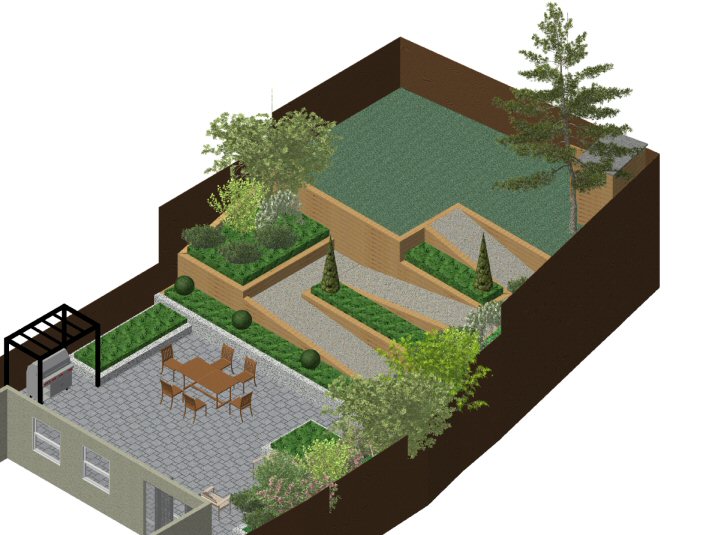
I've designed the route up the garden as three linked shallow ramps with railway sleeper retaining walls. The reason for using railway sleepers for the upper terraces of this garden is simply down to cost. Building walls out of blockwork or bricks is expensive. If I had specified blockwork and render for all the retaining walls it would have pushed the construction costs way over budget. Because sleepers do not need a footing, are much quicker to put up and cheper to buy than hard materials they are a highly cost effective way to create retaining walls. If you use new sleepers and make sure they are neatly finished they can look good in a contemporary scheme. In every garden build there will be compromises, I felt this was one which had to be made and would not ruin the overall aesthetic of the new garden.


If you need help desgining your garden email me linsey@linseysgardens.com or visit my Web site for all other contact details.

Friday, 3 December 2010

Designing a front driveway

Although I hate to say it, sacrificing the front garden for parking where parking space is scarce/non-existent near the house, is sometimes unavoidable and guaranteed to add value to a property. I dislike the idea of turning the front garden into a car park, but understand (from experience) the need for doing so.

Here are some suggestions for what makes a good driveway surface:-

1. Stone setts: these are blocks of stone usually 50 or 100mm square and either 50mm or 100mm deep. They are usually made from granite, basalt or sandstone. Setts are laid on a mortar bed on a compacted hardcore sub-base and pointed with a mortar joint. They make a fabulous driveway surface which is durable, attractive and will take most kinds of traffic. However, they are expensive to buy and lay and drainage will be required.

2. Block paving: block paviors are made of dyed concrete and come in various colours. There are two types of block paving. The first uses paviors of the same size 100mm x 200mm, laid in a regular pattern. The second uses a variety of sizes of pavior laid in a semi-random pattern. Block paving is laid on on sand over a compacted hardcore sub-base and the joints are filled with fine sand. They are cheaper than setts, and are permeable – water runs through the sand in the joints of the blocks. They are also easy to lift if you need to get access to, for example, a service pipe underneath the driveway.

3. Resin-bound/resin-bonded gravel: my absolute favourite. Gravel is either sprayed onto a resin layer thereby sticking it onto the surface, or mixed with resin and applyed to the surface with a trowel. It comes in loads of great colours and unlike loose gravel can be swept. It is hard wearing and gives a lovely natural looking surface. Resin-bound and resin-bonded gravel requires a hard edging – setts, bricks or block paviors are often used – and a sub-base. It is not the cheapest option but can be made self-draining.

4. Loose gravel: this is the cheapest and most often used solution for driveways. You can lay gravel directly onto the sub-soil, but I don’t recommend this. It should be laid on a sub-base over a membrane. A gravel driveway will also need a hard edging to stop the gravel moving onto the pavement and other garden areas. Gravel is self-draining, cheap, looks attractive if well maintained and gives a crunch when walked on that helps with security. It is hard to keep clean as you cannot sweep it and requires maintenance.

5. Stabilised gravel: this involves laying a structure comprising plastic honeycomb pockets which hold the gravel in place. The structure is made up of square sections which join together. Stabilised gravel requires a sub-base and an edging – railway sleepers will do, but setts, bricks, or paviours are also used. A membrane should be laid over the sub-base, but the best system available has a membrane attached to the base of each section avoiding the need for a separate membrane. This system gives a hard surface that can be walked on in heels and driven on by heavy vehicles – I know because I’ve just specified it for a Polo yard car park. It’s a little more expensive than just chucking down a bulk bag of gravel, but will last longer, look better, require less maintenance and is easier to rake clean than loose gravel.

There are other solutions, and a combination of two of the above (some gravel and some block paving, for example) can work well and help get a quality look at less cost. Don’t forget to check with the Local Authority before ripping up the front garden and putting in parking, it’s always worth getting a Permitted Development Certificate. If you want to avoid the SUDS (Sustainable Urban Drainage Systems) legislation check the requirements and make sure your scheme is compliant otherwise you’ll need planning permission.

Another necessary expense it to get the local authority to drop the kerb so that you can access the driveway. If you do not do this people can still legally park in front of your new driveway.

One final plea, if there is space, include some planting to soften the scheme and keep the front of the house looking more like a garden and less like a car park.

Have a look at these front gardens in Woking, Surrey, Crowthorne, Berkshire and Chiswick, London.

If you need help designing your garden please visit my Web site to have a look at some of my work. All contact details are on the Web site.

Thursday, 18 November 2010

Sloping Garden in Gerrards Cross, Bucks - Update 1

Visited site yesterday for the first time since construction started. Although destruction is a more appropriate term for what's going on in the garden at present.


I love this part when the old garden is taken down to reveal the skeleton on which my new design will be built.


This garden has a 3m drop from top to bottom. I'm used to surveying tricky spaces and usually love doing sloping sites. However, this garden was a devil to survey with plants in the way and multiple level changes. The contractors will check my levels carefully before starting construction.


The garden is not huge, so it's very important that all measurements are accurate - even the smallest discrepancy will have an effect on all parts of the plan. The contractors will double check all my measurements before putting in any of the retaining walls.


It's an old property and we're not sure what's under the existing garden, although nothing alarming has shown up so far.

If you'd like help designing your garden please visit my Web site for telephone contact details, or simply email me linsey@linseysgardens.com.

Tuesday, 16 November 2010

Sloping Garden in Gerrards Cross

Slopes - I love 'em! This garden in Gerrards Cross is exactly the kind of challenge I like. It is on a steep slope, and the only access is through a church at the rear of the property.

The client has had the interior of this traditional property updated in a more contemporary style and wanted a garden that reflected the inside of the house.


A much larger patio area is required.


The planting has become overgrown and the retaining walls need replacing.


The clients love gardening, but wanted the garden to have more structure and for the planting to be more manageable.


The top of the garden catches the last of the day's sun and the clients requested a large lawn area where they could sit in the evening.


A more gentle route up the garden is required.


Here's the garden is designed for them.


There will be planting and a pergola on the upper lawn terrace although this is not shown on the plan. The green, pointy cones in the ends of the horizontal borders will be Cupressus sempervirens (Italian Cypress) which were requested by the client.


The build started this week and I can't wait to see the garden take shape.

If you'd like help designing your garden please visit my Web site for telephone contact details, or simply email me linsey@linseysgardens.com.

Saturday, 23 October 2010

Fragrant Shrubs for your Winter Garden

Winter can often be overlooked when planning a planting scheme. My clients always ask for year-round interest in their planting schemes, so I have some recommendations for plants that really come into their own in the Winter months.

Some of the most fragrant plants are those which flower in winter. The reason for this is they are trying extra hard to attract the very few insects around at this time of year. Here are some of my favourite winter flowering shrubs:-

1. Daphne odora aureomarginata: this is one of my favourite shrubs. It’s evergreen with a variegated leaf and small pink highly fragrant flowers. It holds a nice tight shape and can be pruned if it gets too big for its allotted space. It will also tolerate shade, and prefers a well-drained alkaline soil.

2. Viburnum bodnantense ‘Charles Lamont’: another great plant that will grow in sun or shade. Give it some space as it can get quite large, although you can keep it pruned. It is deciduous, with clusters of pale pink fragrant flowers on bare branches throughout the winter. It will grow virtually anywhere in any kind of soil.

3. Sarcococca confusa: an evergreen shrub with gorgeous scented white flowers, and an interesting arching habit. You will be able to smell the scent of its rather insignificant flowers all over the garden. It is highly shade tolerant and can be planted under trees. It is not fussy about soil type.

4. Lonicera frangrantissima: a shrubby deciduous honeysuckle with cream flowers with a gorgeous sweet scent. It will tolerate some shade, but does better in full sun. Give it some space as it can get quite large and looks better with just a little light pruning. It will grow in any kind of soil.

5. Osmanthus burkwoodii: this is a fantastic evergreen shrub which makes an excellent hedge. It has white flowers that appear in late winter and are very fragrant. It will grow in sun or shade and any type of soil. It performs best when kept well pruned.

6. Chimonanthus praecox: best grown against a warm, sunny wall. This shrub has pretty yellow, fragrant flowers with brownish purple centres on bare stems throughout the winter. In summer it has attractive glossy, lance-shaped leaves. A lovely fragrant shrub, its stems are often cut and used in flower arranging. It will grow in all soil types.

7. Mahonia x media ‘Charity’: one of my least favourite plants due to its overuse in municipal planting schemes. Mahonia can be used to good effect at the back of a border where its architectural foliage and plumes of yellow fragrant flowers do light up a dull winter day. But do keep it pruned or it will get huge, woody and hideous. It will tolerate shade and any soil type.

8. Hammamelis: commonly known as Witchhazel, this lovely shrub is a must for the winter garden. Delicate, spidery flowers which can be either yellow red or orange appear in late winter on bare branches. The subtle, unusual scent from the flowers is a real treat in the midst of winter. It prefers an acid to neutral soil and will grow in shade. Although it’s deciduous the leaves also provide lovely autumn colour.

If you’d like help with your garden please get in touch. Please visit my Web site and have a look at some of my work.

Wednesday, 13 October 2010

New work from artist Nate Frizzell

Some more amazing art by Nate Frizzell. I had to look twice as I thought it was a photograph. He's so talented.

Saturday, 2 October 2010

Dwarf Japanese Anemones

Anyone who's ever worked with me knows I love Japanese Anemones (particularly Queen Charlotte) and whenever I plant a garden I try to fit some in. The problem with them is they are tall and can get bashed down by the autumn rains. Here's a link to Graham Rice's new plants blog introducing four new dwarf varieties of Japanese Anemone - I'll certainly be using them.